The Secretary Problem

Problem Statement
How do you choose the best option when decisions are irreversible? The Secretary Problem is a classic optimal stopping problem: given n candidates interviewed sequentially, you must accept or reject each immediately with no option to revisit. Mathematics tells us a surprisingly elegant answer exists.
This project uses Monte Carlo simulation to empirically verify the theoretical optimal stopping rule and explore how different strategies perform under varying conditions.
Methodology
Simulation Design
We simulate 1,000 independent hiring scenarios, each with 100 randomly ranked candidates. The core strategy tested is the 1/e rule: reject the first ~37% of candidates to establish a quality baseline, then accept the next candidate who exceeds that baseline.
The simulation sweeps the stopping threshold from 1% to 99% of the candidate pool, measuring success probability at each point to map the full performance curve.
Results
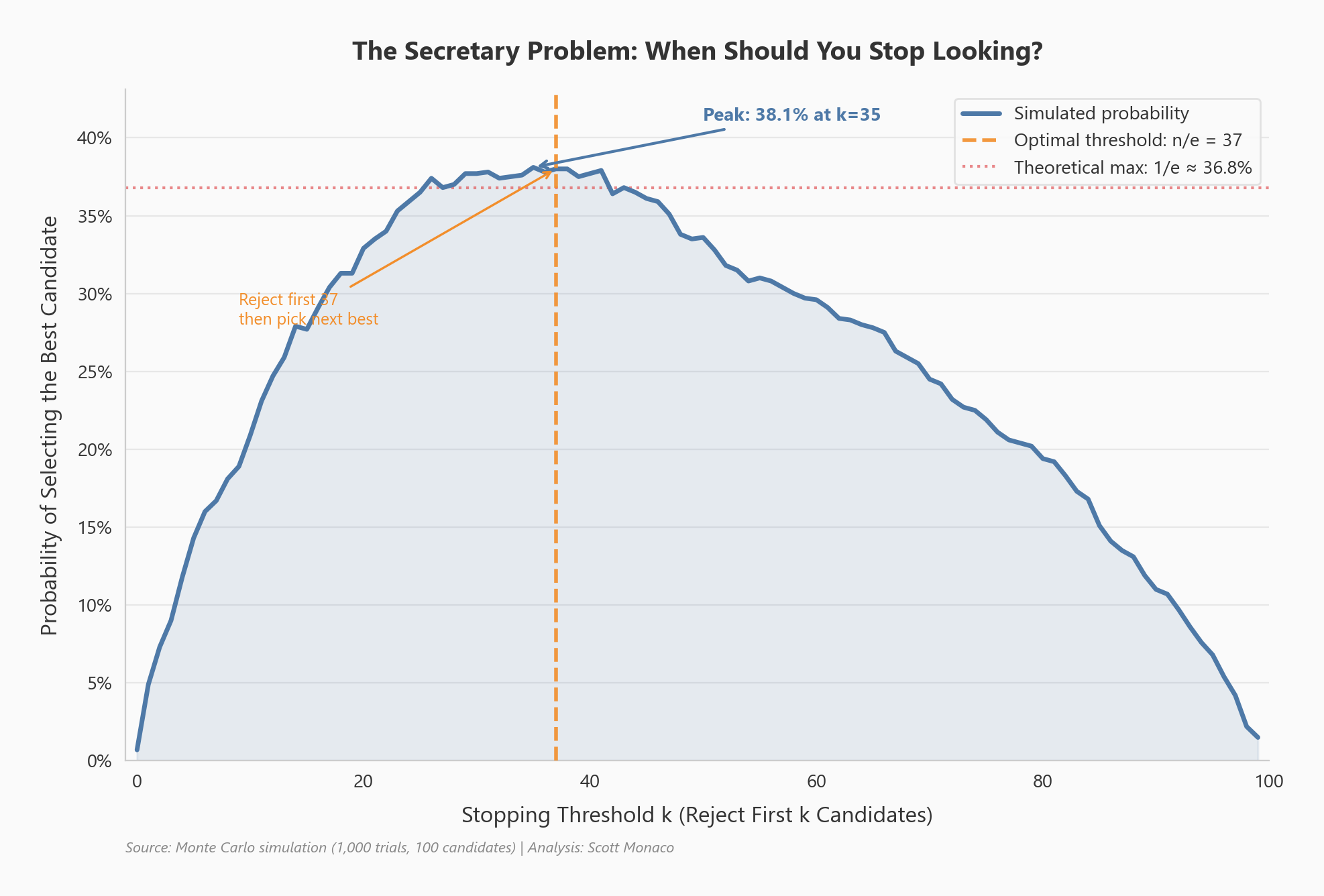
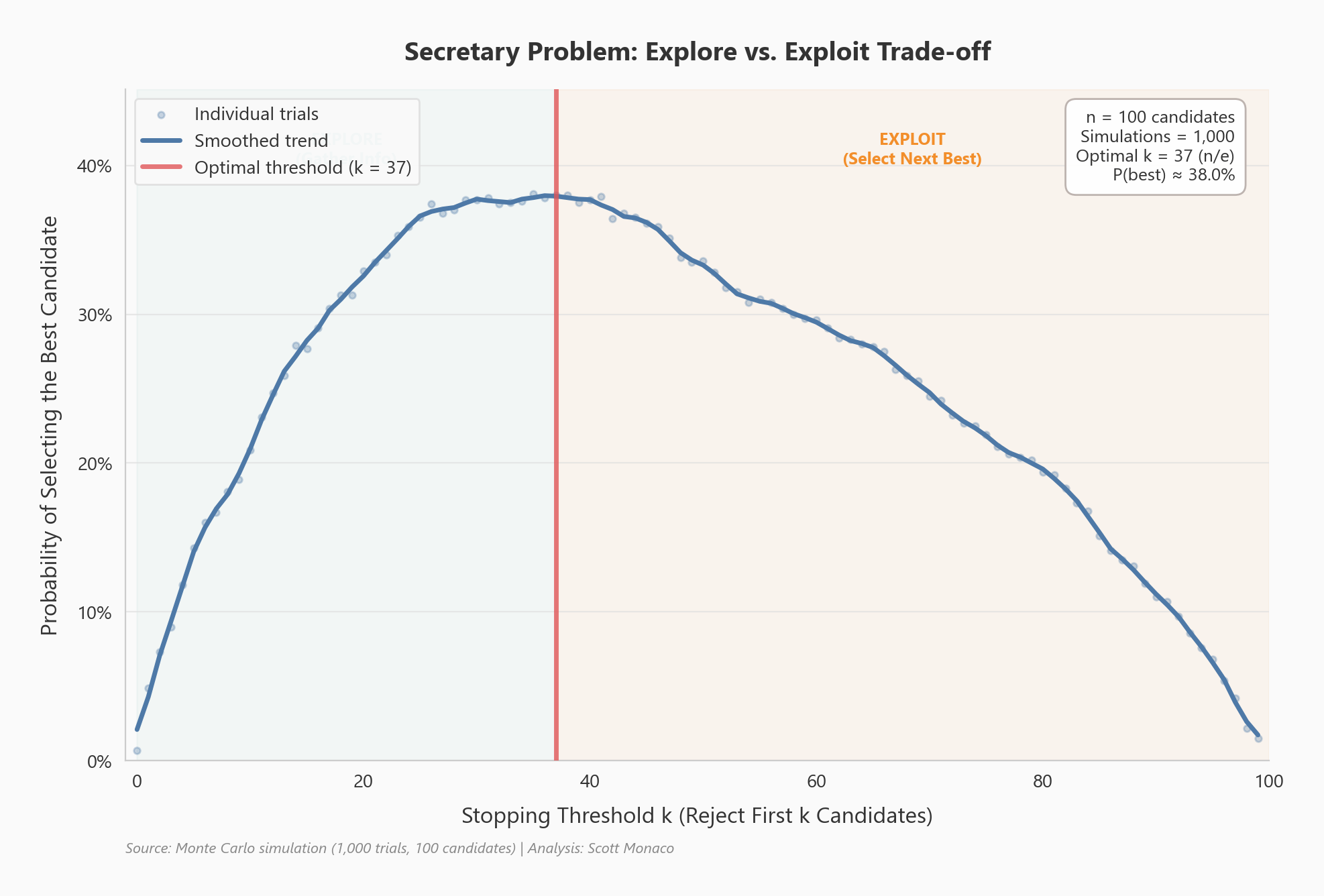
The simulation confirms the mathematical theory: stopping at 37% maximizes the probability of selecting the best candidate, achieving a ~37% success rate (versus ~1% for random selection from 100 candidates).
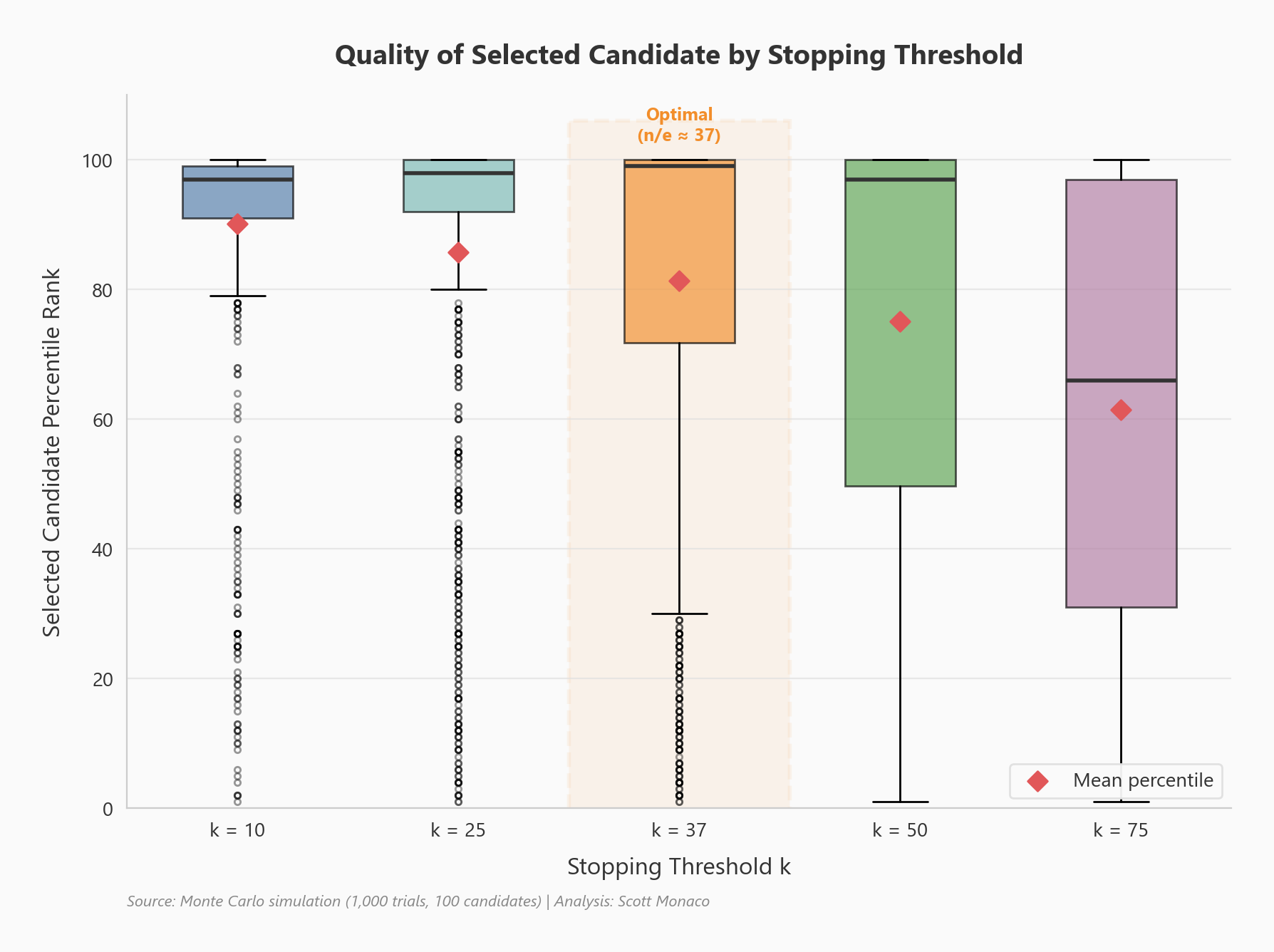
Key Takeaways
The practical implication is clear: when making sequential, irreversible decisions, use the first third of your options purely for calibration. After that point, commit to the next option that exceeds your established baseline.
This principle extends well beyond hiring - it applies to apartment hunting, vendor selection, and any scenario where you must decide sequentially without recall.
Next Steps
- Extend the simulation to variable pool sizes and measure how robustly the 37% rule holds
- Implement a Bayesian approach that updates the optimal threshold as information is gathered
- Explore multi-criteria selection where candidates are ranked on multiple attributes