The Golden Canary: Asymmetric Gold Price Responses to Labor Market Shocks Across Monetary Regimes
Gold is supposed to be the asset that pays off when the labor market cracks. This paper asks whether the data actually behave that way, and finds something more interesting: gold does respond to unemployment surprises, but the response is lopsided, and the entire relationship changed character when quantitative easing arrived in November 2008.
The design
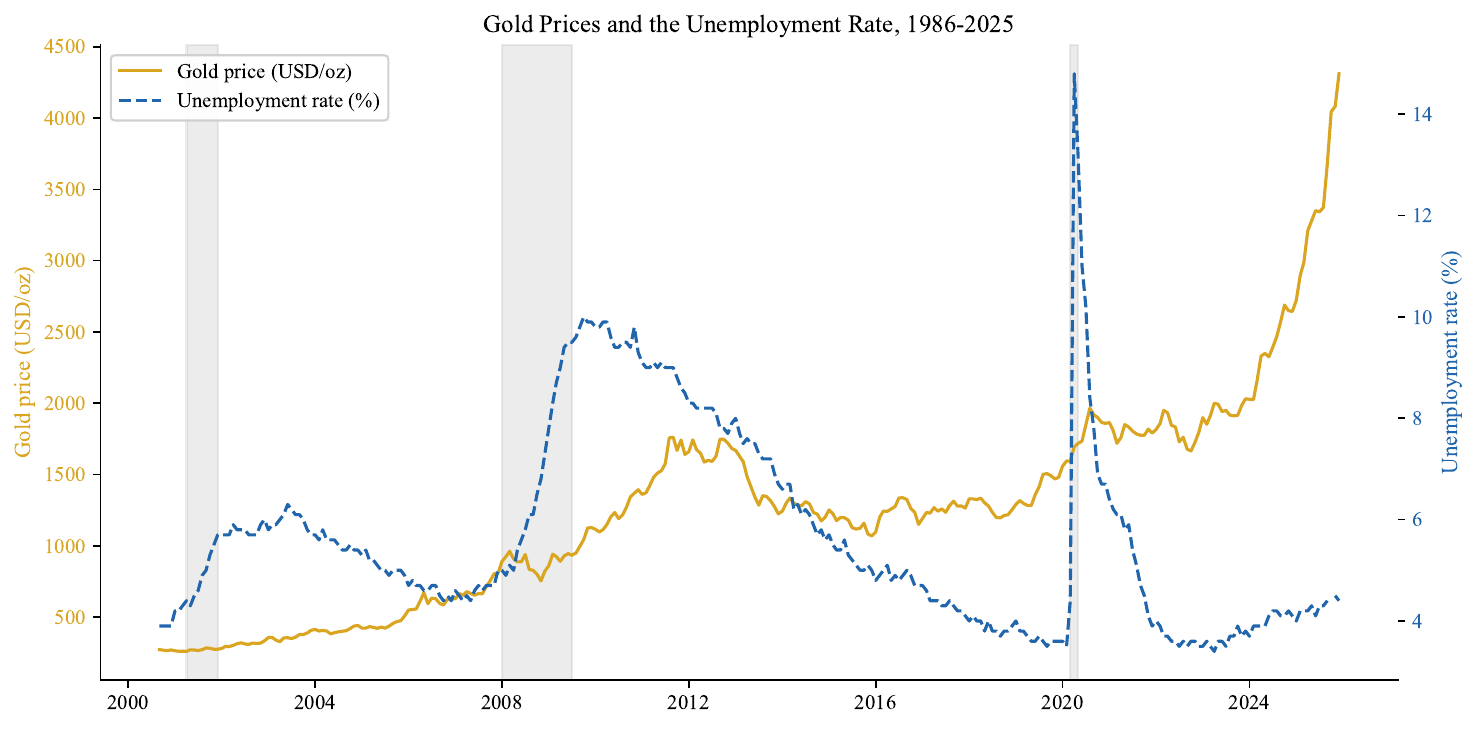
The raw ingredients are monthly gold prices and the U.S. unemployment rate from 2000:09 to 2025:12. Movements in unemployment that markets already expect should be priced in advance, so the paper first strips the predictable part with an AR(6) model and keeps the residuals: unemployment innovations, the genuine surprises. Local projections then trace cumulative gold returns over horizons from 0 to 24 months after each surprise. The hero chart shows the two series over a quarter century: gold marching from under $300 to above $4,000 an ounce, with recessions shaded.
The baseline: gold hears bad news
At short horizons the textbook story holds. An unexpected one-point rise in unemployment is associated with an immediate gold appreciation (a coefficient of 0.008 with a t-statistic of 2.33 on impact) that cumulates to roughly 1.9% over six months (0.019, t = 2.50). Two channels point the same way: bad labor news lowers expected real rates, which flatters a zero-yield asset, and it raises uncertainty, which feeds the safe-haven bid.
The asymmetry: it hears good news louder
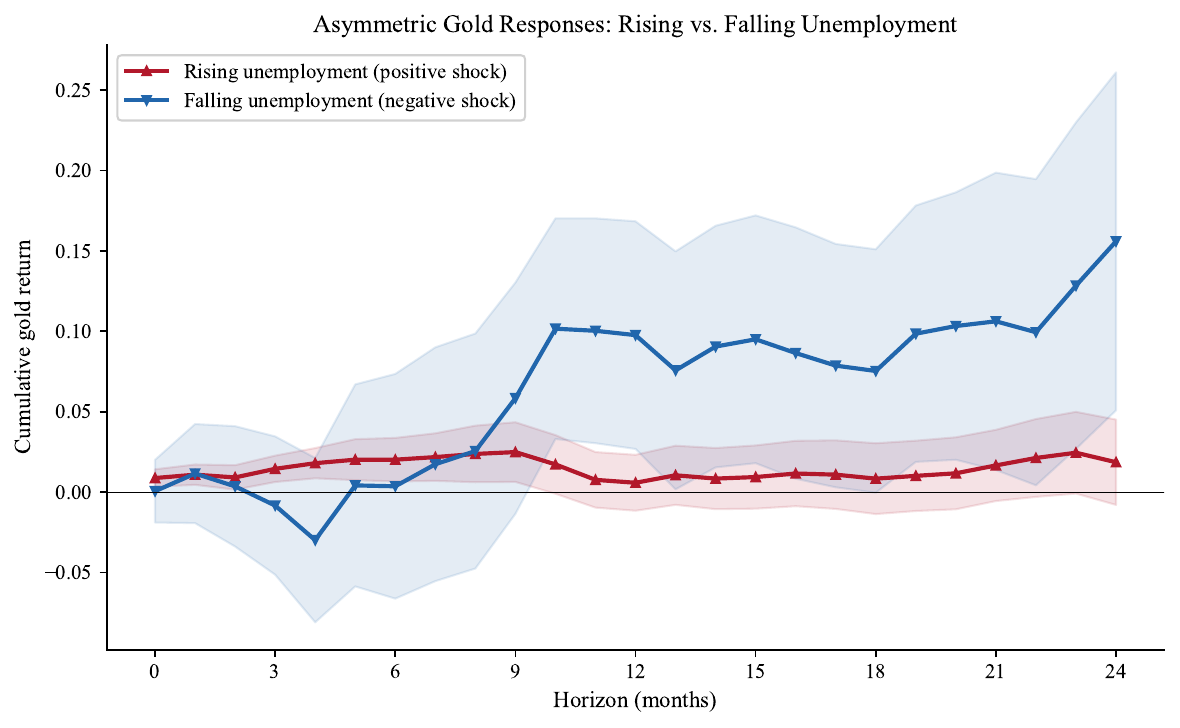
Split the surprises by sign and the symmetry assumed by most hedging rules of thumb breaks down.
The QE break
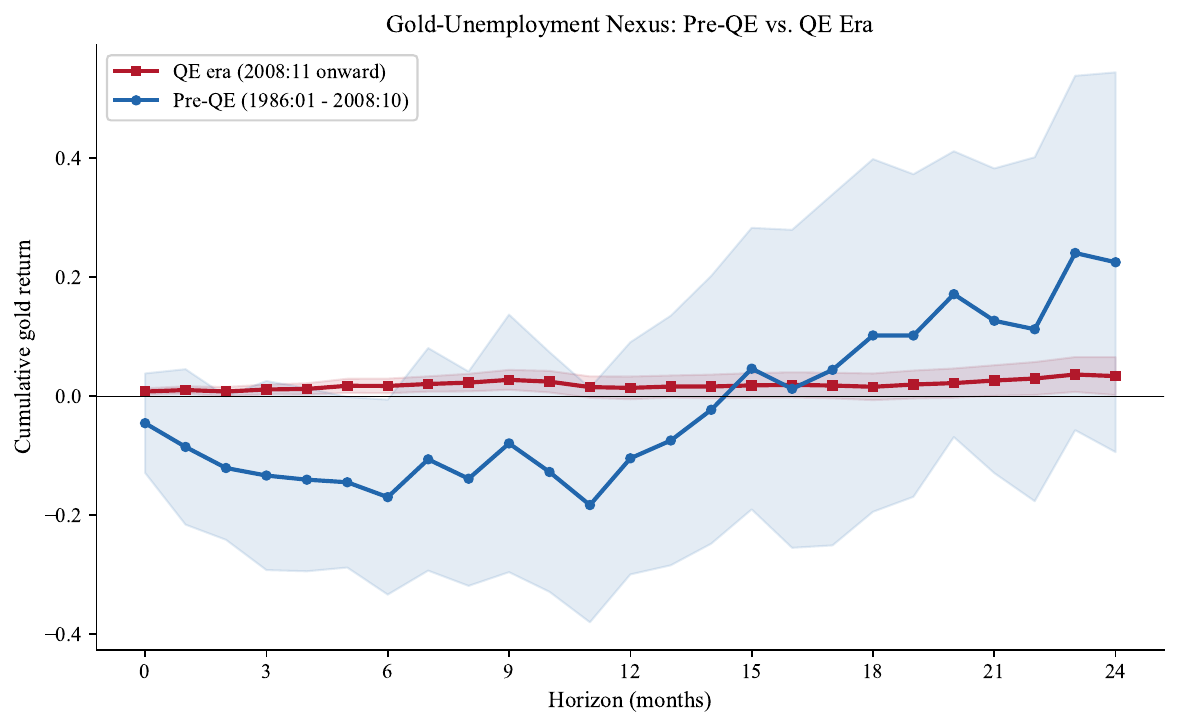
The sharpest result is a regime shift. Before November 2008, the gold-unemployment relationship is negative and imprecise; from the start of quantitative easing onward it is positive and significant at short horizons.
Caveats, honestly stated
The innovations come from a full-sample AR(6), which introduces a look-ahead bias a real-time trader would not have; permutation inference at the 12-month horizon gives p = 0.162, so the baseline result is directionally consistent rather than bulletproof; and the structural model is deliberately stylized. The asymmetry and the regime shift are the findings that survive the robustness battery most cleanly.
What to do with it
For an investor, the asymmetry says gold’s hedging value is state-dependent: it earns its keep on the way into a downturn from an expansion, precisely when hedges matter most, and it quietly re-rates when strong labor data pull tightening forward. For a policymaker, the QE-era sensitivity of gold to labor news is a market-based barometer of how aggressive the expected policy reaction is, a form of revealed-preference evidence on forward guidance. The full derivations, state-dependent estimates, and robustness checks are in the paper.